


Therapeutic Rock Climbing
SOMATIC SKILL BUILDING FOR SELF-EFFICACY AND REGULATION
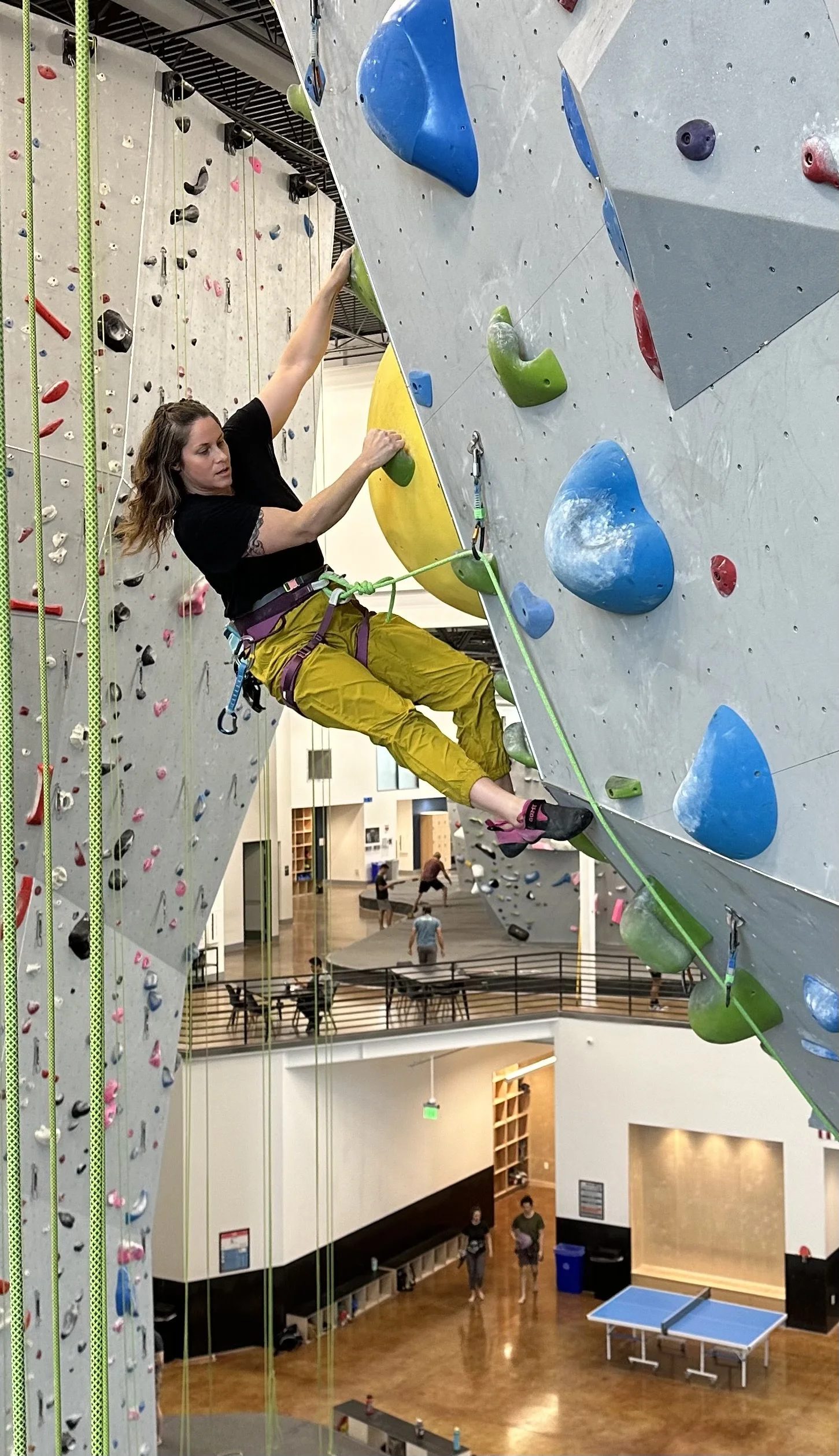
What happens on the climbing wall doesn’t just stay on the wall. Most people might think of rock climbing as body movement only, or a daredevil sport for only the risk-takers among us, but it can be so much more.
Rock climbing can offer a somatic experience that translates the physical activity of movement up the wall into lasting changes for the brain and self, including mood-boosting effects, self-esteem building, relational support, and more.
At Ensemble Therapy, we provide one-on-one rock climbing as an adventure therapy modality to support children to navigate new environments and situations, expand critical thinking skills to solve problems, and create new foundations that redirect children toward greater autonomy, resilience, and confidence.


How can rock climbing be therapeutic?
Just like how certain types of therapy aim to improve or reestablish a mind-body connection that’s specific to your child’s needs, rock climbing can be a physical therapeutic outlet to further strengthen that connection in a dedicated way.
Especially when used in as a complementary activity along with other established psychotherapeutic methods, rock climbing has the possibility to:
Improve physical coordination, balance, and motor skills both on the wall and off
Create deeper and long-lasting moderation of the severity of the symptoms of depression and anxiety
Support new ways of learning, processing, and utilizing information that extend into other areas of life
Enhance sensory integration, with greater ability to respond and adapt to environmental changes
Build confidence and offer new tools for mental and emotional regulation
Establish new ways of communicating, including positive supportive language for the self and others
Create a container for mindfulness that can increase focus, motivation, and overcoming fears
Let’s look at the basis of these in more detail below:
-
Rock climbing can have a number of therapeutic benefits from a physical standpoint, including improving fine motor dexterity and grip strength, encouraging refinement of gross motor skills, building hand-eye coordination, improving flexibility, and strengthening the core along with all major muscle groups.
All of these physical changes over time can significantly improve a climber’s overall mobility, longevity, and quality of life outside of the climbing gym, making a tangible difference in their ability to engage with the world with more ease and fewer preventable injuries.
-
Research in using rock climbing as a therapeutic modality is still growing, but many exercise activities are already proven to drop stress hormones and stimulate neurotransmitters like serotonin, which facilitates feelings of happiness and mood stabilization (Tocino-Smith, Juliette, 2019). It stands to reason that climbing likely offers similar benefits by acting on similar parts of the body and brain.
Physical exercise is now under the German guidelines for the treatment of depression and anxiety, and the sport of rock climbing is already a part of the overall treatment plan in several of the country's mental health facilities (Karg, Dorscht, Komhuber & Luttenberg, 2020).
-
Rock climbing builds essential critical thinking and self-advocacy skills that can be applied to other areas of life. Studying the sections of a climbing route (the direct line of handholds on a climb) asks a climber to assess the risk, visualize movements, and make judgment calls based on their personal comfort level and external risk factors. The process of data gathering, assessment, and visualization trains the brain to use foresight, store information, and recall important information, even when facing a challenging moment.
Because it’s a relatively niche activity and area of study, there are few if any clinical studies measuring the positive effects of rock climbing on executive functioning skills, but anecdotal evidence also points to a greater ability to act, think, and solve problems.
-
High levels of self-efficacy promote psychological resiliency that positively affect one’s ability to access coping skills and to use them persistently, especially in challenging or threatening situations. Whether outside in nature or in a climate-controlled rock gym, this sport provides ample opportunity to meet mental and physical obstacles, face fears and worries, increase positive responses to difficult life situations, and foster self-empowerment with each personal success.
Rock-climbing is not only a wonderful way to build these intrapersonal skills, it’s a clinically backed one. In a randomized controlled trial, participants were randomly assigned to a bouldering psychotherapy group or to a cognitive behavioral therapy group to measure for significant indicators of increased self-efficacy over a 10-week period. This study defines self-efficacy as “people’s beliefs in their capabilities to perform difficult or novel tasks to attain desired outcomes.” Though both trials performed well, the results showed that the bouldering psychotherapy group reported clinically relevant gains in building their perception of self-efficacy when compared to the cognitive behavioral therapy group (Kratzer, Luttenberger, Karg-Hefner, Weis & Dorscht, 2021).
-
Facing a fear of heights, engaging with the discomfort of trying new things, and quieting social anxiety to climb with a new group of people are just a few of the ways that climbers are faced opportunities to overcome challenges and prove to themselves that they can. Over time, much of the fear and anxiety about a climb can be quieted before even touching a climbing route because the unknown is now known, and there’s an understanding of what the challenge may feel like, whether achieving it or not..
With repeated attempts on the wall, climbers can develop a healthier response to fear, and feel a sense of reassurance in their abilities to meet challenges in a productive way. In this way and many others, climbing can strengthen planning, reasoning, and skills for adaptation that translate to the world outside the gym.
-
Climbing is all about communication! Both bouldering and sport climbing use communication constantly for safety purposes, route planning, helping each other through challenges on the wall, and for emotional and mental support. In bouldering, partners spot the climber so they hit the padded mat in case of a fall, and in sport climbing, they are literally the lifeline to stop acceleration in a fall with the rope.
Rock climbing can provide a way to practice speaking up and self-advocating, communicating needs and feelings, and exercising positive supportive language for the self and others. It also provides a potential shared interest to use as a basis to create new friendships and connections. Climbers often want to engage by asking about gear, discussing or planning routes, and even cheering a fellow climber on when they reach for the top of a climb.
-
The connection between mindfulness and rock climbing can be two-fold, with mindfulness both as an inherent part of climbing and an intentional way to improve the climbing itself.
A controlled study in 2021 explored the relationship between mindfulness and rock climbing and how mindfulness-based techniques are intentionally incorporated into the training programs of rock climbers, regardless of personal or professional level. This same study focused on how mindfulness can increase focus and motivation, overcome fears, increase body awareness, strengthen breath control, and improve visualization within climbing. Mindfulness during climbing can even create a flow-like state similar to a “runner’s high” that is said to be “a state of mind believed during to occur during optimal human experience.” (Wheatley, 2021).
As with the other therapeutic benefits of rock climbing, mindfulness can start on a climbing route but become a tool in all kinds of other daily life activities.
For more information on the therapeutic benefits of rock climbing, you can read our therapist Shawna’s take on the blog, “Rock Climbing is Therapeutic?”


Services
Our rock climbing sessions balance teaching your child the necessary care and caution to respect the inherent physical risk of the activity, while at the same time fostering a sense of confidence and right-sized challenge for wherever your child is that day.
One-on-one sessions are a way to give our full focused attention to your child in order to create a warm, inviting experience, with an appropriately tailored level of risk.
Sessions take place at Mesa Rim Austin climbing gym with a safety and belay-certified professional therapist.
Initial Diagnostic Assessment, 45 minutes, $195*, or 60 minutes, $250*
Rock Climbing Session, 60 minutes, $195*
*Note: there is an additional $30 cost for a youth day pass and climbing harness and shoe rental, paid separately to the climbing gym, Mesa Rim Austin.
If your child has experienced mild to serious health concerns, we recommend you consult with their physician and medical professionals to determine whether this is the right therapeutic activity for them at this time, and to let us know if any accommodations or modifications need to be made to best meet their needs.
How does the process work?
♡
How does the process work? ♡
Step 1: FREE 15-MINUTE PHONE CALL (OPTIONAL)
This optional first step is for you if you still feel like you need more information before you and your child move forward with the process. We’ll have a free, 15-minute phone consultation with you to discuss your general questions and concerns. This is not a time where we will assess your child’s specific needs, but rather to help you decide if this is the right therapeutic modality for your child at this time.
Step 2: 45 OR 60 MINUTE INITIAL DIAGNOSTIC ASSESSMENT
Prior to getting into the rock climbing gym, you and your child will meet with their therapist for an initial diagnostic assessment. This session is when intake and evaluation takes place, and it lasts either 45 or 60 minutes. You will discuss your concerns and hopes for your child, as well as any prior physical or diagnostic concerns around the therapeutic experience. You will to help your child’s therapist build a profile of the child’s specific therapeutic needs and assist in the beginning phases of goal setting for treatment planning purposes.
Your child’s therapist will use this initial assessment as a guide for goal setting with the child during sessions and compiling a treatment plan after several sessions of therapeutic engagement. You will also return to it as as a benchmark for regular parent consultations every 6-8 weeks.
Step 3: THE ROCK CLIMBING!
Based on your child’s treatment plan and goals, your child will meet with their therapist on a regular basis at the rock climbing gym to learn the fundamentals of climbing and wall safety, and, when ready, get vertical on the wall! While we suggest taking a tour of the gym prior to the first session, there is always an opportunity to have a walkthrough tour on the first day of sessions to get oriented. See the frequently asked questions below to get a good sense of what being in the rock climbing gym is like and how each session might look.
Step 4: GOAL SETTING AND TREATMENT PLAN
During the first three climbing sessions, your child’s therapist will set goals with them, and after the first six sessions, the therapist will establish a treatment plan based both on those goals and overall developmental objectives.
Step 5: CAREGIVER CONSULTATIONS
Every 6-8 weeks, you’ll have an opportunity to discuss your child’s progress and their needs during caregiver consultations. We’ll review the treatment plan, come back to the set goals, and adjust the plan as needed based on what’s best for your child.

Our Approach to
Therapeutic Rock Climbing
Just like how no child is the same as another, or develops the same as another, your child’s progress on the climbing wall is all their own. We know that your child is coming to the climbing wall with their own existing fears, abilities, and beliefs, so we provide dedicated support that speaks to the realities of their mind and body on the day we see them.
We also know that you might be coming to the idea of your child trying rock climbing with your own fears and beliefs too, which is why we make a point to communicate all along the way with transparency and reassurance.
Some days on the climbing wall may feel all-play to your child, but you can rest assured that no matter the session, our approach comes from a research-based foundation in child development, psychology, education, kinesiology, and biology and research-based intervention strategies to help your child succeed in climbing higher, whatever they scale next.
The relationship your child builds with their therapist during rock climbing sessions, as well as the supervised and appropriately sized challenges they face, can create a positive basis for the relationship they have with themselves and how they grow to approach and engage with the world around them.
READY TO GET STARTED?



Meet Our Therapist for Rock Climbing
Shawna West, LPC, RPT™, NCC, ASDI, C-CAT
Shawna West (she/her/hers) has been an active rock climber for 20+ years, and considers herself a lifetime beneficiary of the therapeutic properties of climbing. Through the sport of climbing, she has developed self-confidence, mindfulness, resilience, and an ability to conquer many fears on the wall and off — essential tools she uses daily to ensure positive growth, stability, and intrapersonal success both for herself and every child she works with.
Shawna is a Licensed Professional Counselor (LPC), a National Certified Counselor (NCC), a Certified Autism-Informed Professional (ASDI), and is working towards her Registered Play Therapist™ (RPT™) credential and her Certified Clinical Adventure Therapist (C-CAT) credential under the clinical supervision of Dr. Cristine Norton LCSW-S, C-CAT. Shawna received her Master’s Degree in Professional Counseling from Texas State University (CACREP Accredited Program) and a Bachelor’s Degree from the University of North Texas in Comparative Literature and Women and Gender Studies.
Ready to get climbing with Shawna?
Still have questions?
♡
Still have questions? ♡
We understand that you might want to know more before you commit to beginning the process of signing up for therapeutic rock climbing for your child, and this is also just good information to have! Here are some of our most frequently asked questions:
-
Each rock climbing session is $190 for 60 minutes. This fee is for the dedicated one-on-one support, supervision, and therapeutic expertise personalized to your child and their needs.
The Initial Diagnostic Assessment prior to getting in the climbing gym is either $195 for 45 minutes or $250 for 60 minutes.
There is an additional $30 cost for a youth day pass and climbing harness and shoe rental at the climbing gym, Mesa Rim Austin. This cost will be paid separately to the climbing gym.
-
Depending on the scheduled appointment time, the gym could be near empty or very busy. In a climbing gym, there are many sensations; music, talking, bright lights, different textures such as the climbing holds and special paint on the walls. These sensations may be exciting and novel to experience, but they may also be particularly overstimulating. If your child experiences sensory overload at any point, we will take breaks in one of the outside areas of the gym. It is always okay to take a quiet break or an activity break such as stretching or ping pong to provide a redirection. Your child’s therapist will be gently monitoring your child’s needs throughout to determine what activities or pauses may be necessary.
-
Common exercises often look like stretching or an active warm up such as jumping jacks, jump rope or ping pong. As your child becomes more comfortable on the wall, we will incorporate more skills based movement and even challenge games to build strength, body awareness, grounding, frustration tolerance, and self-esteem. Your child will get to set their own goals to work toward and to assess progress, and what we do in the gym depends on what those goals are. Maybe they want to climb one of the taller walls a quarter, a half, or all the way up. Maybe they want to be able to take a fall on the top rope without being scared. Maybe they want to try a harder graded route. Your child’s therapist is always looking to gently expand your child’s current mindset and abilities, but ultimately your child is the one with agency and direction.
-
Therapeutic rock climbing sessions are confidential, but we are in a public space where you might see your child climbing. If your child gives you verbal permission, you may watch or take pictures from the viewing balcony.
-
There are inherent risks in rock climbing just as there are with all sports activities. The rock climbing gym is fully staffed by expertly trained professionals and the facilities are designed for optimal safety. Our rock climbing therapist, Shawna, has taken and passed multiple belay certification tests to prove that she has met safety and efficiency standards for Mesa Rim Austin.
-
If your child can stand, they can climb. Children are more capable and adventurous than we adults give them credit for. As long as the child has the right-sized gear and a responsible, trained adult right there with them to keep the child safe, climb on!
-
Yes, absolutely! Rock climbing is diverse, non-judgmental, identity-affirming, and accepting of any and all human beings who wish to climb. The sport of rock climbing has come a long way in efforts to build better practices of inclusivity. It is not uncommon to enter a climbing gym or an outdoor climbing area and find people of different races, cultures, religions, genders, and sexualities. Rock climbing is accessible to individuals who are neurodiverse or neurodivergent, disabled, blind/legally blind/low vision, Deaf and hard of hearing, and even those who use a wheelchair. The list goes on!
-
We highly recommend visiting the Mesa Rim Austin climbing gym for a personal tour, viewing images from their website, or using the internet to find inspirational videos of children rock climbing.
Our therapist Shawna encourages caregivers and parents to read her blog post, “Rock Climbing is Therapeutic?” to learn more about the purpose of therapeutic rock climbing. When talking to their children about therapeutic rock climbing, the blog post can help guide parents through the why’s, and websites and videos can help understand the how’s. Shawna also recommends that parents visit their local REI or the Mesa Rim gear center to look at climbing gear up-close.
-
Reach out to us and we can have a free 15-minute consult call to answer any additional questions and concerns you might have before moving forward with the process. There’s no pressure or obligation to sign your child up on that call, just an opportunity to get more clarity to help whatever decision you make easier.